
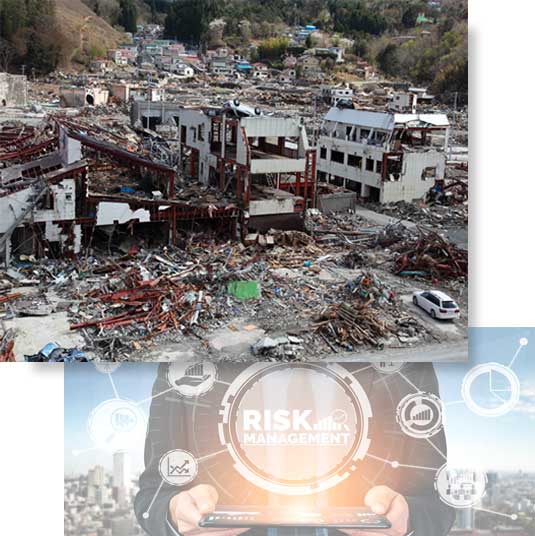
Global Warming Brings Disasters. Parametric Insurance Brings Recovery.

Where traditional insurance falls short, our parametric solutions step in. Using verifiable data to trigger automatic payouts, they protect against previously uninsurable climate risks—ensuring swift financial recovery to safeguard your assets and revenue after a disaster.

Global Warming Brings Disasters. Parametric Insurance Brings Recovery.

Where traditional insurance falls short, our parametric solutions step in. Using verifiable data to trigger automatic payouts, they protect against previously uninsurable climate risks—ensuring swift financial recovery to safeguard your assets and revenue after a disaster.

PARAMETRIC INSURANCE

Traditional insurance often fails to cover new-era threats like
climate disruption or cyber outages. Parametric insurance closes this gap, using verified data to trigger automatic, rapid payouts when a predefined event occurs.

This innovative solution is essential for modern businesses seeking financial resilience—offering certainty and immediate cash flow to recover from disruptions that standard policies may not cover.

Parametric Protection

Transparent Coverage, Rapid Recovery

Our parametric insurance solutions, offered through our insurer partners, simplify disaster recovery through a transparent three-step process:

STEP 1: Define the Terms

Together, we establish your policy based on verifiable parameters (e.g., cyclone wind speed and distance) and a preset indemnity, so you know exactly what is covered.

STEP 2: Independent Verification

We rely on trusted third-party data from global agencies (including NOAA and JMA) to impartially monitor for triggering events, ensuring total objectivity.

STEP 3: Swift Financial Support

When a trigger is met, we facilitate the claims process with the insurer to ensure you receive compensation quickly, often in a matter of days, providing immediate liquidity after a disaster.

Parametric insurance minimizes your administrative burden by relying on a limited set of key data points, such as:

  • Asset Location: Provided via GPS coordinates or a site address.
  • Historical Loss Data: To help calibrate the coverage (if applicable).
  • Hazard-Specific Data: For some perils, this may include feed from on-site sensors or other verified sources.

FAQ

A parametric policy covers any economic loss sustained from a triggering event including but not limited to property damage, business interruption, and extra expenses. There does not have to be direct physical damage to trigger coverage.

The payout structure is designed by our insurer partners based on your specific needs. We will work with you to design a custom structure that typically uses circular zones (like a bullseye) around your location. Each zone has a pre-agreed payout value that is triggered if a event of a certain intensity reaches it. Our role is to facilitate this process, ensure the terms are clear, and negotiate the best structure on your behalf.

In the event of a potential loss, our streamlined process ensures clarity and rapid resolution.

  1. Notification: The process begins when you, the client, notify us (your broker- ION Group HK Ltd) and/or the risk carrier (the insurer).
  2. Insurer Verifies the Data: The insurer collects the final data from an independent certification agent to authoritatively determine if the policy was triggered and to what level.
  3. Insurer Issues the Report: Based on this data, the insurer produces an event report that details the payable amount according to your policy's terms.
  4. You Submit the Declaration: You then provide a formal Declaration of Loss Statement to the insurer.
  5. You Receive Payout: The insurer issues the payout directly to you, as stipulated in the policy, ensuring swift financial support for recovery.

Our Role as Your Broker: We guide you through each step, facilitate communication with the insurer, and ensure the process is executed fairly and efficiently on your behalf.

To ensure objective and reliable triggers for parametric policies, our insurer partners use the maximum sustained wind speed—specifically the one-minute sustained wind speed—as reported by the Joint Typhoon Warning Center (JTWC).


This metric represents the highest average wind speed measured over a one-minute period within the storm, typically observed near its center. It offers a more consistent and accurate correlation with potential damage compared to gust wind speed, which can be short-lived and less representative of the storm’s overall destructive force.

By relying on sustained wind speed—a standard used by meteorological agencies worldwide—we help ensure that trigger determinations are based on stable, verifiable data, leading to faster and more transparent payouts.

Our insurer partners rely exclusively on objective, third-party data from the world’s most authoritative meteorological agencies to verify triggering events. This ensures full transparency and enables swift, unbiased claims resolution.

  • In Southeast Asia, policies are triggered using storm track and intensity data provided by the Joint Typhoon Warning Center (JTWC).
  • In other regions, equivalent agencies are used—such as the National Hurricane Center (NHC) and NOAA in the United States, the Bureau of Meteorology (BOM) in Australia, and the Japan Meteorological Agency (JMA).

Enquire

Send us a message when we would be glad to assist you.

    We respect your privacy and committed to protecting your personal data. Your data will be processed in accordance with our Privacy Policy. Terms & Conditions applies.

    Serious about Risk.
    Relentless about Solutions.

    ION Insurance Brokers - Protecting People. Empowering Businesses.
    Today's Care, Tomorrow's Confidence.

    • 183 Electric Road, Level 43, Unit 26, North Point, Hongkong
    • +852 96717672 (HK)
    • +65 94883164 (SIN)
    • 9 am - 6 pm

    // width=
    Our customer support team is here to answer your questions. Ask us anything!